Jun 27, 2026
Honeycomb Paper Pallet vs. Wooden Pallet: Which is Better for Global Export?
Stop paying to ship dead weight. Compare honeycomb paper pallets vs wooden pallets. Learn how to cut air freight by 40% and by pass ISPM-15 customs delays.

For decades, the wooden pallet has been the default choice for global shipping. But in today’s era of skyrocketing air freight rates and strict environmental regulations, is it still the smartest choice?
If you are a supply chain manager or packaging engineer exporting high-value goods to the EU or US, you are likely paying a massive hidden tax: Dead Weight.
In this comprehensive guide, we compare traditional wooden pallets with FSC-certified honeycomb paper pallets across four critical metrics: Freight Costs, Customs Compliance, Load Capacity, and ESG impact.
TL;DR: The Quick Verdict
Choose Wooden Pallets if: You are shipping domestically, storing goods outside in heavy rain, or operating a closed-loop pallet pooling system.
Choose Honeycomb Paper Pallets if: You are exporting via air freight, need to bypass ISPM-15 fumigation delays, require custom dimensions, and want to reduce your carbon footprint to meet EU ESG standards.
- Freight Costs: Stop Paying to Ship "Dead Weight" The most significant difference between wood and honeycomb paper lies in the tare weight. A standard wooden pallet (1200x1000mm) weighs between 15kg to 20kg. In contrast, a Maxwell TecX honeycomb paper pallet of the same dimensions weighs only 3kg to 5kg. The Math (ROI Calculation): Let’s assume you are shipping 100 pallets by air freight at a rate of $5.00 per kg. Wood Weight: 100 pallets × 15kg = 1,500 kg Paper Weight: 100 pallets × 3kg = 300 kg Weight Saved: 1,200 kg Total Freight Savings: 1,200 kg × 5.00 = 6,000 saved in a single shipment.
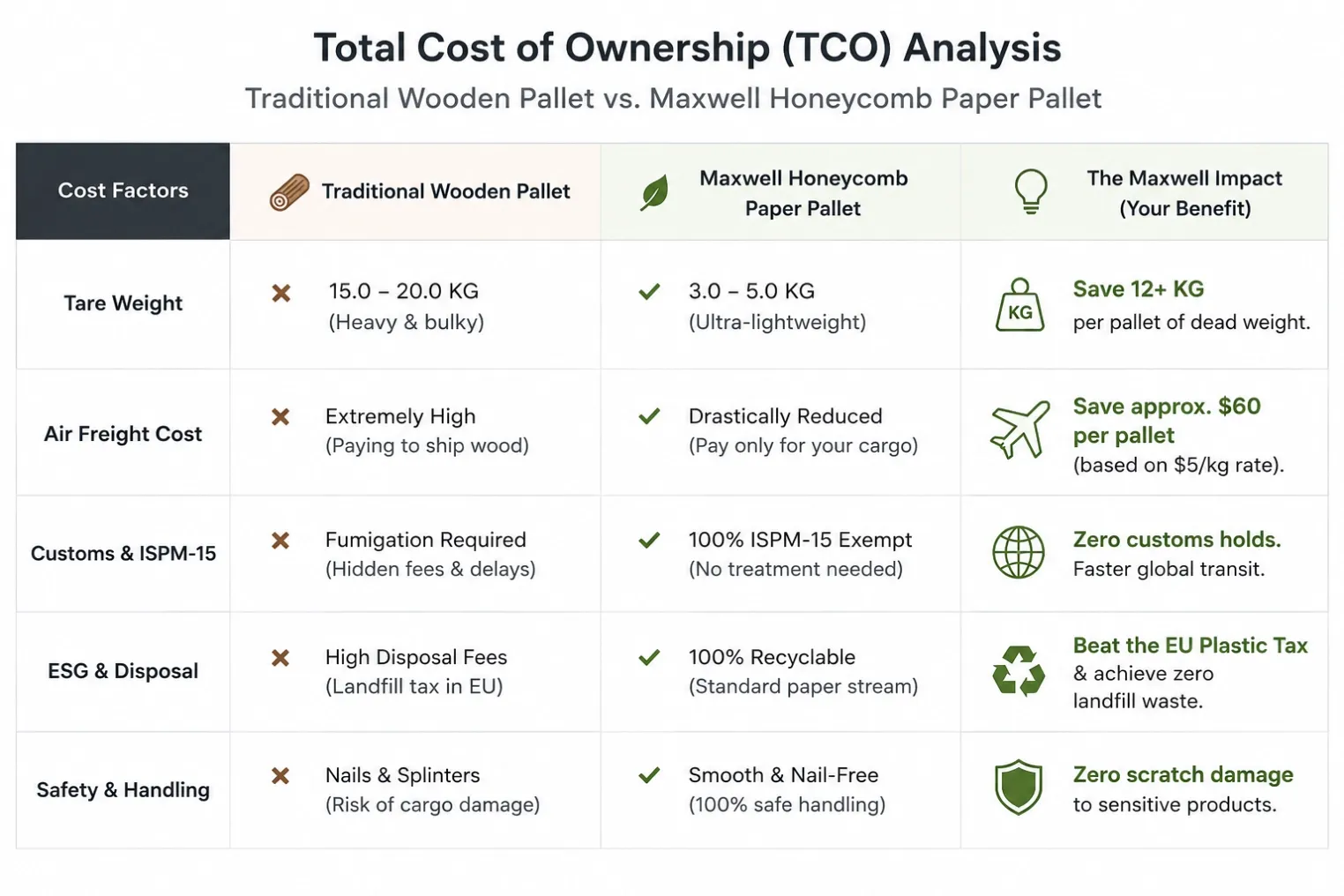
By switching to paper pallets, you instantly turn logistics expenses into bottom-line profit.
2. Customs Compliance: The ISPM-15 Headache
When exporting internationally, wooden packaging materials must comply with ISPM-15 regulations. This means every wooden pallet must be heat-treated or fumigated and stamped to prove it is free of pests. Missing or illegible stamps can result in your entire shipment being held at customs, quarantined, or even destroyed.
The Honeycomb Advantage:
Honeycomb paper pallets are manufactured from processed corrugated kraft paper. Because they are not made of raw wood, they are 100% exempt from ISPM-15 regulations. No fumigation, no heat treatment, no hidden customs delays. Your cargo moves seamlessly across borders.
Load Capacity: Is Paper Strong Enough?
A common misconception is that paper cannot handle heavy industrial loads. This is a myth.
Inspired by the hexagonal structure of a beehive, engineered honeycomb paper provides exceptional compressive strength. Maxwell TecX honeycomb pallets can be customized to support:
Dynamic Load (in transit): Up to 1,000 KG
Static Load (in warehouse): Up to 2,000 KG
Furthermore, unlike wood, paper pallets have no nails and no splinters, eliminating the risk of scratching sensitive cargo (like medical devices or solar panels) and ensuring a safer environment for warehouse workers.
4. ESG and Sustainability: Beating the Plastic Tax
As the European Union and other global markets enforce stricter environmental laws (such as the EU Plastic Tax), brands are under immense pressure to optimize their packaging.
Wooden pallets are often difficult to recycle at their final destination, leading to high disposal fees for your end-users. Maxwell TecX honeycomb pallets are FSC-certified and 100% universally recyclablein standard cardboard streams. You empower your end-users with frustration-free disposal while significantly lowering your brand's carbon footprint.
Conclusion: Engineered for the Future of Export
While wooden pallets still have their place in domestic logistics, they are a costly liability for international air and sea freight. Honeycomb paper pallets offer a superior, cost-effective, and eco-friendly alternative for modern exporters.
Ready to calculate your exact freight savings?